
Current ventilation guidelines recommend maintaining ventilation with 100% outdoor air 24/7, or as much as possible if that is not feasible. Obviously, outdoor air needs to be filtered and conditioned to guarantee the indoor temperature and humidity set points; this, in turn, implies a higher HVAC-related primary energy consumption, because more outdoor air needs to be conditioned compared to the pre-COVID-19 situation, when the flow of outdoor air was typically 20% of the total supply air entering the space.
Is it possible then to minimise primary energy consumption to reasonable levels, and even to values that are similar to the pre-COVID-19 situation?
It appears so, based on simulations carried out in four different European climates: Athens, Berlin, Madrid, and Milan.
In order to save energy, recovering as much as possible from the exhaust air is of paramount importance. Therefore, a heat exchanger between the exhaust and the supply air flows is a big plus in the AHU used to simulate the four cities.
Evaporative cooling, both direct and indirect, helps to reduce the energy consumption related to cooling.
Modulation of all devices in the AHUs (coils, evaporative coolers, blowers, etc.) brings an additional advantage, as operation of the devices is modulated so as to provide no more than necessary, i.e. exactly the required heating/cooling, or the supply air flow based on actual occupancy.
The AHU used in the simulation is illustrated in the following three images. The AHU is the same; what differs is the way the supply air is generated:
- Pre-pandemic scenario: ventilation is on duty 12 hrs/day; supply air (constant flow) is composed of outdoor air (20%) and recirculated air (80%); humidification is by steam (electric); the heat exchanger is not bypassed; no indirect evaporative cooler is installed.
- Pandemic scenario: ventilation is on duty 24/7; supply air (constant flow) is composed of 100% outdoor air; humidification is by steam (electric); the heat exchanger is bypassed as per ventilation guidelines; no indirect evaporative cooler is installed..
- Post-pandemic scenario: ventilation is on duty 24/7; supply air (variable flow) is composed of 100% outdoor air; humidification is by direct evaporative cooler; the heat exchanger is not bypassed and it is assumed there is no cross-flow contamination; an indirect evaporative cooler is installed and running.
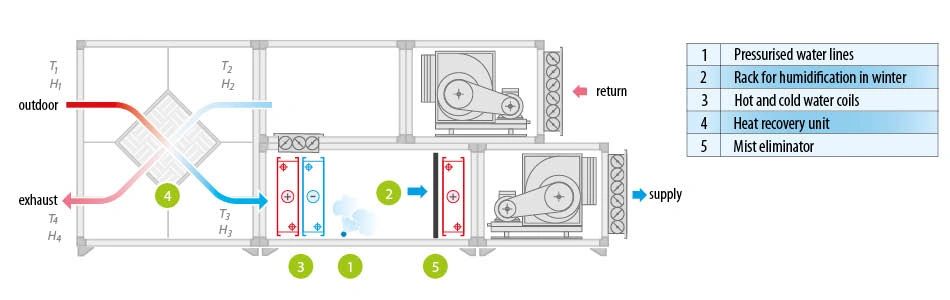
- Air flow Q= 31,600 m3/h
- Heat recovery ζ= 73% sensible, bypass on/off
- Isothermal humidification from electrical source
- Percentage of outside air = 20%
- Percentage of recirculated air = 80%
- Constant air flow management (CAV)
- Operation 12 hours/day

- Airflow Q= 31,600 m3/h
- By-passed heat recovery
- Isothermal humidification electric source
- Percentage of Outside Air = 100%
- Percentage of Recirculated Air = 0%
- Constant airflow management (CAV)
- Operation 24 hours/day

- Air flow Q= 31,600 m3/h
- Heat recovery ζ= 73% sensible, bypass modulating
- Adiabatic humidification
- Percentage of outside air = 100%
- Indirect evaporative cooling with heat recovery unit dampening
- Percentage of recirculated air = 0%
- Variable air flow management (VAV)
- Operation 24 hours/day
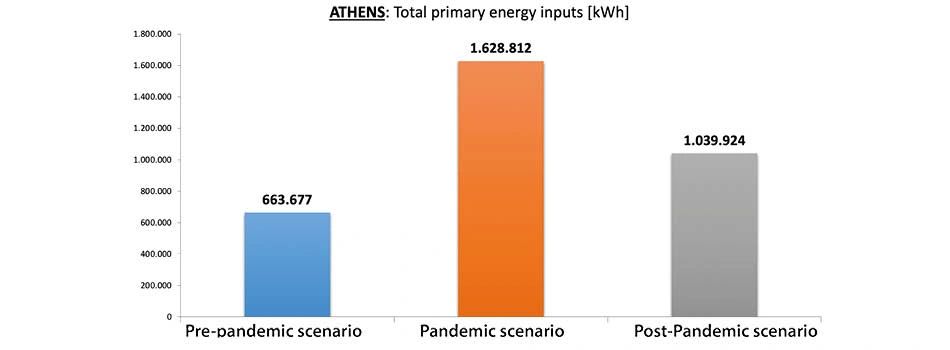
In all four cities, the simulations generate similar results:
- Pre-pandemic scenario: baseline.
- Pandemic scenario: there is a large increase in primary energy consumption, as the amount of outdoor air to be conditioned increases from 20% in the pre-pandemic scenario to 100%.
- Post-pandemic scenario: primary energy consumption is reduced dramatically compared to the pandemic scenario, reaching values similar to those in the pre-pandemic situation, due to modulation, heat recovery and evaporative coolers.

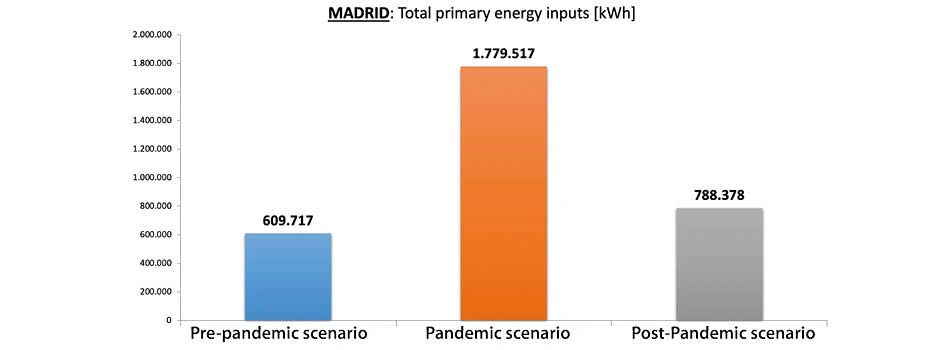
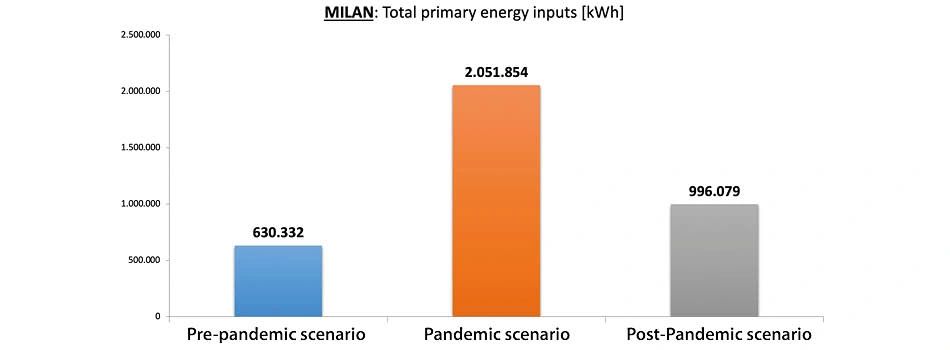
Once the current pandemic is deemed over, we will return to normal. Yet, depending on the climate, it will be possible to have ventilation with 100% outdoor air, but with primary energy consumption close to the pre-pandemic scenario; and the same will be true for running costs. This will be possible, as Andrea Pagan explains, thanks to fully-modulating ventilation systems, with energy recovery, evaporative coolers, and control and monitoring systems capable of getting the most from the devices they drive.
Climate Systems provides fresh commercial HVAC innovations to the Sioux Falls area. Call 605.334.2164, email info@climatesystemsinc.com or visit climatesystemsinc.com to learn more.
Source: “Reducing the primary energy associated with air changes,” Raul Simonetti, Carel