
by Jeremy Goodroad EIT, LEED® AP BD+C, Equipment Sales Manager, Climate Systems Inc.
In a world that continues to demand more power, maximizing energy efficiency can make all the difference. Commercial and industrial sector fan and blower systems in the U.S. consume approximately 300 billion kWh/year, demonstrating the increasing importance of Fan Energy Index (FEI) and utilizing it to help select efficient fans.
What is Fan Energy Index?
Fan Energy Index (FEI) is an energy consumption metric that considers the impact of all fan system components. Higher FEI values ultimately lead to lower energy consumption, meaning reduced operating costs and carbon emissions. This comprehensive measurement also allows for more accurate fan comparisons, providing insight on various factors:
- Energy efficiency: by taking a system-wide view of the actual fan at its duty point, FEI allows for a more accurate picture of its energy consumption.
- Operation noise: more efficient fans operate at lower speed or employ a more efficient rotor, reducing noise during use.
- Reliability: because it involves a comprehensive analysis of the fan’s performance, a higher FEI tends to signify when a fan has a more flexible operating range.
Why FEI?
Historically, fan selection was commonly based on the fan shaft input power or the fan’s aerodynamic efficiency at the duty point (CFM and static or total pressure). Fan Efficiency Grade (FEG) was later developed as a standardized metric for evaluating the aerodynamic efficiency of the fan itself, without considering motor or drive losses. While important, both of these metrics presented a partial representation.
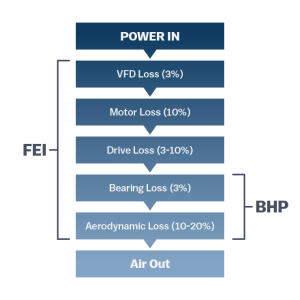
FEI provides a more comprehensive measure than past standards because it considers the electrical input of the complete fan system, including the fan, motor, and drive. Other metrics, such as brake horsepower (BHP), which considers only bearing loss and aerodynamic loss, provide an incomplete picture of the fan’s performance. The intent of FEI is to improve fan selections and reduce fan system energy consumption.
Today, both ASHRAE 90.1 and the IECC use the Fan Energy Index to evaluate fan energy efficiency. For applicable fans, these standards generally require a minimum FEI of 1.0 at the design operating point, with certain exceptions and provisions for specific fan applications.
The Role of FEI in Fan Selection
Utilizing tools like Computer Aided Product Selection (CAPS) or eCAPS from Greenheck allows engineers to make better equipment selections for their application by identifying metrics like FEI. A higher FEI often results in quieter, more flexible operating range and helps point to the most suitable fan for the application.
Whether you are a facility manager, owner, or engineer, a great way to optimize your design or facility is to reference the latest edition of ASHRAE 90.1 and the applicable Energy Code, which state a minimum FEI requirement and require AMCA FEI Certified rating performance. Another great way is to include a minimum FEI requirement on your schedule.
If you are interested in maximizing your energy efficiency by implementing equipment that meets Fan Energy Index standards, let’s talk. We can discuss options to best fit your building’s needs.
—
Jeremy Goodroad EIT, LEED® AP BD+C
Equipment Sales Manager
Climate Systems Inc.