
by Justin Van Kirk, Business Development, Climate Systems Inc.
Dividing your seasonal tasks between in-house quick checks and certified technician services optimizes system performance and prevents mid-winter breakdowns. As summer comes to a close it is time to plan ahead to the heating season.
Ensure your commercial or residential heating system operates safely, efficiently, and reliably during the cold months, by utilizing preventative maintenance every fall.
Documentation Matters
If you didn’t write it down, it didn’t happen. Keeping a maintenance log for every unit serves three important purposes. First, it helps you spot trends. If one unit keeps needing refrigerant, you likely have a slow leak that needs more than just a top-off. Second, it protects your warranties, as manufacturers often require proof to honor parts coverage. Third, it makes expense planning easier. Knowing which units are becoming money pits gives you the data you need to justify a replacement budget to ownership before it becomes a crisis.
General In-House & Facility Maintenance
Recommended tasks to complete before switching your HVAC system to heat mode.
Air Filtration:
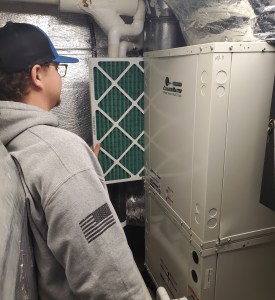
- Replace air filters with high-efficiency rated replacements.
- Ensure filter access doors are tightly sealed.
Outdoor Units & Vents:
- Clear leaves, brush, and trash at least 2 to 3 feet away from outdoor condenser coils.
- Inspect exterior exhaust flue pipes and fresh-air intake pipes for bird nests or blockage.
Cooling Towers
- Completely drain the cold-water basin, hot water distribution basins, and all low-point piping.
- Ensure proper freeze protection, chemical treatment, and mechanical inspection are critical to preventing cracked piping, ruined coils, and severe equipment damage.
Advanced Facility Maintenance
Commercial gas furnaces, boilers, and advanced heat pumps can be a little more technical to maintenance and get ready. You want a certified HVAC technician to perform these procedures:
Boilers:
- Combustion Analysis, inspect boiler shell, piping connections, circulating pumps, expansion tanks, and valves for rust, scaling, or signs of water leakage.
- Inspect and flush the condensate trap and drain lines to remove sediment or bio-slime buildup.
- Verify the condensate neutralizer media is replenished and not exhausted.
Furnace:
- Heat Exchanger: Examine the heat exchanger for hairline cracks, rust, or soot buildup.
- Burners & Igniter: Clean burner assembly tubes, test ignition switches, and polish the flame sensor rod.
A Smarter Approach to Building Operations
Preventative maintenance isn’t just a line item on a service contract. It’s one of the most cost-effective decisions a building owner or facility manager can make. The buildings that run the most efficiently and longest are the ones that treat maintenance as a priority rather than an afterthought.
This is where we come in, let Climate Systems assist you this Fall in preparing for the heating season. Our technicians are trained in advanced HVAC equipment and are prepared to help you get ready. We can help you identify concerns, improve efficiency, and help you budget for the future by notifying you of trends.
If you are looking to outsource your preventative maintenance, let’s talk. We can find the right option to best fit your building’s needs.
—
Justin Van Kirk
Business Development
Climate Systems Inc.